Anatomically contoured fixation

Patient Specific
Plates

Custom fixation plates for orthognathic surgery, trauma reconstruction, fibula mandibular reconstruction, and genioplasty.

Before you submit a case

Imaging & data requirements

How to acquire the CT/CBCT we need to design patient-specific fixation plates — our requirements from your side, on one printable sheet.

Download PDF
01 · The concept

From Virtual Plan to Stable Fixation

A patient-specific plate is a titanium plate shaped in advance to the planned bone position, not bent by hand during surgery. Its form follows the target anatomy, the osteotomy lines, and the chosen screw zones.

Because it fits only one way, the plate does two jobs at once: it holds the bone, and it helps guide the bone into the planned position. When it seats correctly, the segment position and final contour follow predictably.

Planning variables
Fit
plate surface adapted to patient anatomy
Position
holes aligned to the planned segment relation
Safety
screw corridors checked against roots, nerves, and defects
Strength
bridge zones and thickness adapted to mechanical demand
Transfer
plate geometry supports intraoperative repositioning
Custom plate families

One planning principle, multiple indications

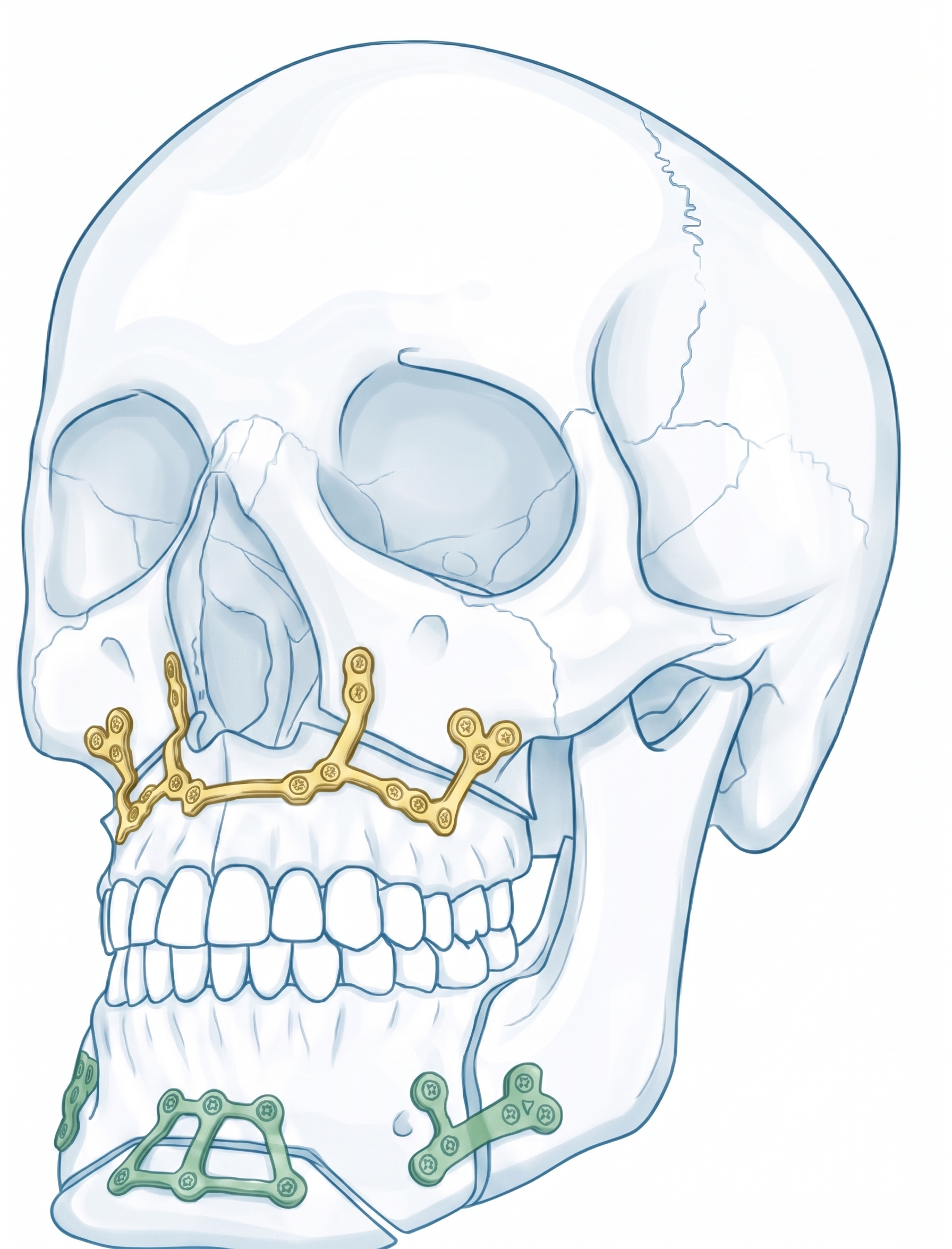
Plate design starts with the clinical objective. In orthognathic surgery the plate stabilizes a planned jaw position. In trauma it restores reduction. In fibula reconstruction it connects graft segments into a mandibular contour. In genioplasty it fixes the mobilized chin segment in the planned position.

The same design logic is used across these indications: plate path, screw distribution, bridge stiffness, anatomical fit, and surgical access are reviewed together before manufacturing.

Custom maxillofacial plates for orthognathic surgery, trauma, fibula reconstruction, and genioplasty
Custom plate concepts for maxillary fixation, mandibular reconstruction, trauma stabilization, and genioplasty
02 · Indications

Orthognathic, Trauma, Fibula Reconstruction, and Genioplasty

Each plate type is planned around a different surgical problem, but all require precise fit, controlled screw placement, and a stable relation between the planned bone segments.

Orthognathic surgery

Jaw repositioning plates

For Le Fort I, BSSO, or bimaxillary cases, plates are designed after the final occlusion and skeletal movement have been defined. The plate links the mobilized segment to the stable skeleton and helps transfer the virtual jaw position.

Screw holes can be coordinated with osteotomy lines, tooth roots, maxillary sinus anatomy, and planned guide positions.

Trauma

Reduction and fixation plates

In trauma reconstruction, the plate is shaped to the restored anatomy after fracture reduction or mirror based reconstruction. It can bridge comminuted regions, stabilize fragments, and support restoration of facial projection and continuity.

The design focuses on safe screw purchase, access through the planned approach, and reliable fixation outside unstable fracture zones.

Fibula reconstruction

Mandibular reconstruction plates

For fibula free flap reconstruction, the plate defines the reconstructed mandibular arch and stabilizes each fibula segment in the planned order. Plate holes can be matched to fibula cutting guides and mandibular resection guides.

This allows the reconstruction geometry, segment angles, occlusal relation, and later implant planning space to be considered before surgery.

Genioplasty

Chin positioning plates

For sliding genioplasty, a custom plate can fix the chin segment after advancement, setback, vertical change, or asymmetry correction. The plate is built around the planned chin position rather than bent freehand intraoperatively.

Screw positions are selected with respect to the mental nerve region, dental roots, osteotomy line, and desired lower facial contour.

03 · Design logic

Plate Path, Screw Corridors, and Segment Control

A patient specific plate is not only a bent fixation device. It is a planned interface between anatomy, surgical access, screw safety, and the desired postoperative bone position.

Plate path

The plate follows a surface that can be reached surgically and seated without rocking. The path avoids sharp transitions and respects the planned soft tissue access.

Screw corridors

Holes are positioned in stable bone and checked against dental roots, neurovascular structures, fracture zones, defect margins, and osteotomy lines.

Segment control

The geometry supports the final relation between segments, including mandibular continuity, maxillary position, chin projection, and graft segment orientation.

READY WHEN YOU ARE

Submit a case, receive a plan.

Send the patient's CT and dental scan through our secure channel. A planning proposal is typically returned within 2–5 working days, case-dependent.